What is Glued IOL Surgery and Who Needs It
Glued IOL surgery is a specialized technique for implanting an intraocular lens (IOL) when the natural lens capsule is absent or too weak to support a standard lens. This capsule normally holds the IOL in place after cataract surgery. When it is missing due to trauma, complicated surgery, or conditions like ectopia lentis, the surgeon must use an alternative fixation method. Glued IOL surgery uses medical-grade fibrin glue to secure the lens to the sclera (the white part of the eye) without sutures. It is not a routine procedure—it is reserved for patients whose eyes lack adequate capsular support.
What is Glued IOL Surgery?
In a standard cataract operation, the surgeon removes the cloudy natural lens but leaves the thin, clear capsule behind. The new artificial lens (IOL) is placed inside this capsule. When the capsule is damaged, missing, or too weak—due to trauma, prior vitrectomy, or conditions like pseudoexfoliation—the surgeon cannot use this method. Glued IOL surgery solves this by creating small scleral tunnels and using fibrin glue to fix the IOL’s haptics (support arms) to the sclera. The glue holds the lens securely in place, and because no sutures are needed, the eye heals faster and with less induced astigmatism.
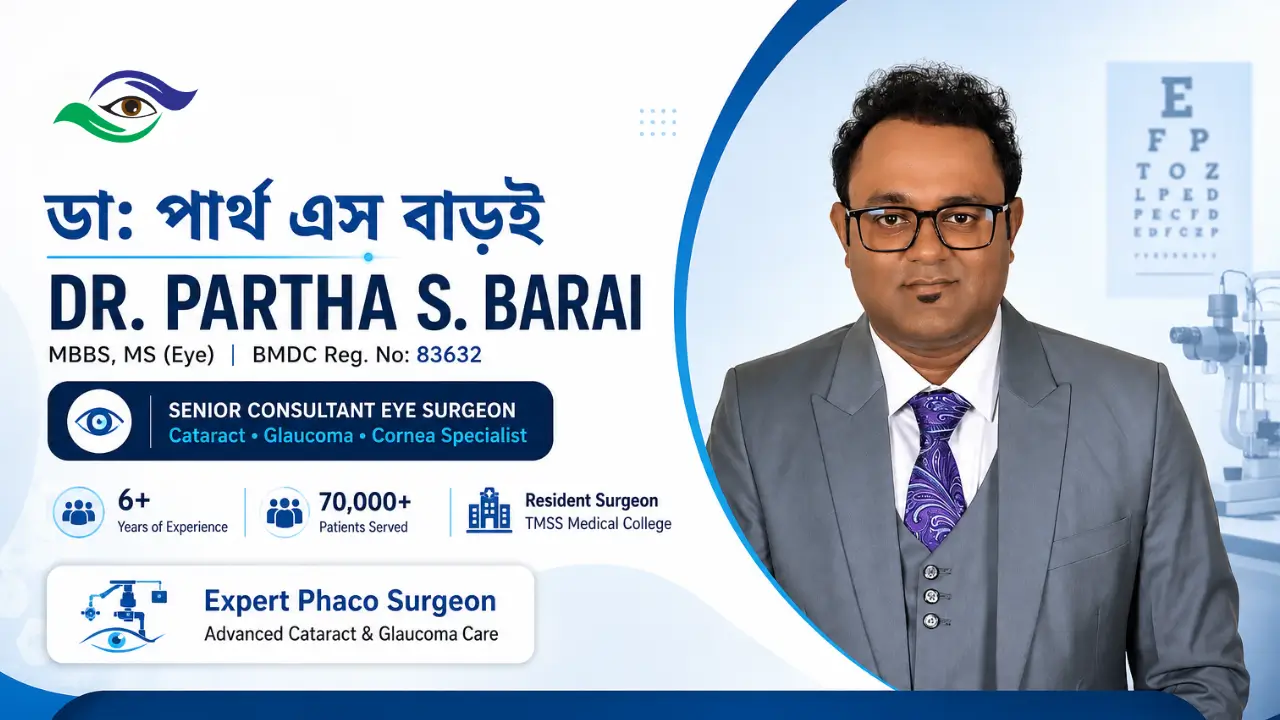
This technique was developed to improve upon older suture-based methods, which carried higher risks of suture breakage, infection, and lens tilt. Today, glued IOL surgery is performed at specialized eye centers by surgeons trained in anterior segment or vitreoretinal surgery. For a detailed evaluation of your condition, you can contact with Dr. Partha S. Barai at his clinic in Bogura.
Who Needs Glued IOL Surgery?
You may be a candidate for glued IOL surgery if your eye lacks adequate capsular support. Common scenarios include:
- Complicated cataract surgery: The capsule ruptured during the procedure, leaving no safe place for a standard IOL.
- Eye trauma: An injury that damages the lens capsule or dislocates the natural lens.
- Lens dislocation: The natural lens or a previously implanted IOL has shifted out of position (e.g., in Marfan syndrome, homocystinuria, or pseudoexfoliation).
- Previous vitrectomy: Removal of the vitreous gel can weaken capsular support.
- Congenital conditions: Ectopia lentis (displaced lens) from birth.
Not everyone with these conditions is a candidate. A thorough eye examination—including slit-lamp evaluation, ultrasound, and sometimes optical coherence tomography—is necessary to confirm that the sclera is healthy enough for the procedure. Only an experienced ophthalmologist can determine suitability. If you have been told that standard IOL implantation is not possible, you may benefit from a consultation at a tertiary care eye hospital. For example, Dr. Partha S. Barai’s clinic provides specialized evaluation for complex IOL cases.
How is Glued IOL Surgery Performed?
The surgery is usually done under local anesthesia (eye drops and an injection around the eye) and takes about 30–45 minutes. Here is a simplified step-by-step overview: If in-person advice is needed, contact with Dr. Partha S. Barai.
- Preparation: The eye is cleaned and numbed. The surgeon makes a small opening in the conjunctiva (the clear tissue covering the white of the eye).
- Creating scleral tunnels: Two or three partial-thickness tunnels are made in the sclera at specific locations. These will hold the IOL haptics.
- Inserting the IOL: The folded IOL is inserted through a small incision and positioned so that its haptics pass through the tunnels.
- Applying fibrin glue: A drop of biological glue is placed over each haptic exit point to seal the tunnels and secure the lens.
- Closing the conjunctiva: The conjunctiva is repositioned and may be glued or sutured if needed.
No stitches are used to fix the lens itself. The glue dissolves over several days as the tissue heals, leaving the IOL firmly anchored.
Benefits and Potential Risks
Benefits:
- No sutures on the lens, reducing the risk of suture-related problems (breakage, infection, erosion).
- Stable lens position with less tilt compared to some older techniques.
- Faster visual recovery and less induced astigmatism.
- Good long-term outcomes when performed by an experienced surgeon.
Potential risks: As with any intraocular surgery, complications can occur. The most common include:
- Infection (endophthalmitis): Rare but serious; prevented with sterile technique and postoperative antibiotics.
- Lens tilt or decentration: The IOL may shift slightly, causing blurred or double vision. This is less common with glued IOL than with suture-fixated methods.
- Glaucoma: Temporary or permanent rise in eye pressure can occur, especially if the angle is compromised.
- Retinal detachment: Slightly higher risk in eyes that have had trauma or prior vitrectomy.
- Cystoid macular edema: Swelling in the central retina that usually responds to anti-inflammatory drops.
Serious complications are uncommon when the surgery is performed by a surgeon with specific training in glued IOL techniques. Discuss your individual risk profile with your ophthalmologist. If in-person advice is needed, Dr. Partha S. Barai.
Alternatives to Glued IOL Surgery
When capsular support is absent, several other IOL fixation methods exist. The choice depends on your eye’s anatomy, the surgeon’s expertise, and your overall health. The table below compares the main options.
| Technique | How It Works | When Used | Key Considerations |
|---|---|---|---|
| Anterior chamber IOL | Lens placed in front of the iris, supported by the angle of the eye. | When the posterior capsule is absent but the anterior chamber is deep and healthy. | May cause corneal endothelial damage or glaucoma over time. Simpler technique. |
| Iris-fixated IOL | Lens clipped to the iris (e.g., Artisan/Verisyse lens). | When the capsule is absent but the iris is intact and healthy. | Requires a larger incision. Risk of iris chafing, inflammation, and pupil distortion. |
| Suture-fixated IOL | Lens haptics are sutured to the sclera using polypropylene stitches. | When glue is not available or the sclera is too thin for tunnels. | Higher risk of suture breakage, erosion, and endophthalmitis. Longer recovery. |
| Glued IOL (scleral-fixated with fibrin glue) | Haptics placed in scleral tunnels and sealed with fibrin glue. | Preferred when the sclera is healthy and the surgeon is trained in the technique. | No sutures, stable lens, faster recovery. Requires specific training and glue availability. |
Your surgeon will recommend the best option based on your eye’s condition. For a personalized assessment, you can contact with Dr. Partha S. Barai at Netraloy Eye Care Center in Bogura.
Recovery and Follow-Up Expectations
After glued IOL surgery, you will need to use antibiotic and anti-inflammatory eye drops for several weeks. You may be asked to wear a protective shield at night to prevent accidental rubbing. Most patients can resume light activities within a few days, but avoid heavy lifting, bending, or swimming for at least two weeks.
Vision may be blurry initially due to swelling and the glue. It typically stabilizes over 2–4 weeks, though full visual recovery can take up to three months. Follow-up visits are scheduled at one day, one week, one month, and three months after surgery to monitor lens position, eye pressure, and retinal health. Long-term follow-up is recommended to detect late complications such as glaucoma or lens tilt.
Cost of Glued IOL Surgery in Bangladesh
The cost of glued IOL surgery varies widely depending on the hospital, surgeon’s fee, type of IOL (foldable vs. non-foldable, aspheric vs. toric), and whether additional procedures (e.g., vitrectomy) are needed. Public hospitals may offer the surgery at a subsidized rate but often have longer waiting lists. Private hospitals in Dhaka, Chittagong, and Bogura typically charge more but provide faster access and more implant choices.
| Item | Approx. BDT Range | Notes |
|---|---|---|
| Surgeon’s fee | 20,000 – 50,000 | Varies with experience; complex cases may cost more. |
| Hospital & OT charges | 15,000 – 40,000 | Includes operation theatre, nursing, and consumables. |
| IOL (foldable, aspheric) | 10,000 – 30,000 | Premium toric or multifocal IOLs cost more. |
| Fibrin glue & medications | 5,000 – 10,000 | Glue is imported and adds to the cost. |
| Postoperative care (drops, follow-up) | 3,000 – 8,000 | Includes antibiotic and steroid drops for 4–6 weeks. |
| Total (typical range) | 50,000 – 1,50,000 | May exceed 2,00,000 if combined with vitrectomy or ICU stay. |
Costs change over time and vary by facility. Always confirm the total estimated expense with your chosen hospital before surgery. For a detailed discussion of options and pricing, you can visit Netraloy Eye Care Center in Bogura.
Frequently Asked Questions
Is glued IOL surgery permanent? Does the glue dissolve over time?
Yes, the fixation is permanent. The fibrin glue used in the procedure is biodegradable and is absorbed by the body over a few weeks. However, the IOL remains securely in place because the glue holds the lens initially while the eye’s natural healing process forms scar tissue that permanently anchors the lens to the sclera. No additional surgery is needed to maintain the position.
Can glued IOL surgery be performed on both eyes at the same time?
Typically, surgeons recommend operating on one eye at a time. Performing surgery on both eyes simultaneously increases the risk of bilateral infection, inflammation, or other complications. Most surgeons will schedule the second eye only after the first eye has healed successfully and the IOL position is stable, usually after a few weeks.
How does glued IOL compare to other sutureless techniques like the Yamane technique?
Both are sutureless methods for IOL fixation when capsular support is absent. Glued IOL uses fibrin glue to secure the haptics in scleral tunnels, while the Yamane technique (intrascleral haptic fixation) creates tunnels with a needle and does not require glue. The choice depends on surgeon preference, patient eye anatomy, and availability of materials. Glued IOL may be preferred in cases with significant conjunctival scarring or when the surgeon has more experience with the glue method. Both techniques have good outcomes when performed by an experienced surgeon.
Is glued IOL surgery available in all major cities of Bangladesh?
Glued IOL surgery is a specialized procedure and is primarily available in tertiary eye care centers and hospitals with experienced vitreoretinal surgeons. In Bangladesh, it is offered in leading institutions in Dhaka, and possibly in some divisional cities like Chittagong or Rajshahi. Availability may be limited in smaller cities. Patients should consult a qualified ophthalmologist to confirm whether the procedure is offered locally and to verify the surgeon’s experience with the technique.
What is the typical recovery time after glued IOL surgery?
Most patients can resume normal daily activities within a few days, but complete visual stabilization may take several weeks. During the first month, patients are advised to avoid heavy lifting, bending, or rubbing the eye. Follow-up visits are essential to monitor healing and ensure the IOL remains stable. The surgeon will provide specific guidelines based on individual recovery progress.