Advanced Phacoemulsification Cataract Surgery Options in Bogura
Cataracts (ছানি) cloud the natural lens of the eye and slowly blur vision. In the past, removing a cataract meant a large incision and stitches. Modern phacoemulsification uses ultrasound to break up the cloudy lens through a tiny opening, and it is the basis of most advanced cataract surgery in Bangladesh. In Bogura, some eye care facilities offer phacoemulsification with additional features — no-stitch wounds, topical anaesthesia, and premium lens implants. This article explains what these options involve, who is likely to benefit, what recovery feels like, and what they may cost in Bogura.
What Is Phacoemulsification and How Does It Compare with Older Cataract Surgery?
Phacoemulsification uses an ultrasound probe through a 2–3 mm incision to break up and remove the cloudy lens. A foldable artificial lens is inserted through the same opening. This differs from manual small-incision cataract surgery (SICS), which needs a 5–7 mm incision and often a suture. Phaco also avoids the much larger opening used in extracapsular cataract extraction (ECCE). Because the wound is smaller, phaco tends to produce less astigmatism and allows faster healing. Many phaco surgeons in Bangladesh now use a sutureless, self-sealing wound. Even so, not every facility in Bogura has moved to phaco; some public hospitals still perform SICS for certain patients. Ask your surgeon which method is recommended for your lens density and eye health.
What Does “Advanced” Phacoemulsification Include?
When a surgeon calls phaco “advanced,” it usually means one or more of these:
- No-stitch wound: The self-sealing incision usually requires no suture, reducing postoperative discomfort and speeding recovery.
- Topical anaesthesia: Anaesthetic drops numb the eye, so many patients avoid an injection around the orbit.
- Microincision instrumentation: Newer phaco machines and smaller probes allow the procedure through a sub-3 mm incision.
- Premium IOLs: In addition to standard monofocal lenses, advanced options include:
- Multifocal IOLs for distance and near vision;
- Toric IOLs to correct astigmatism;
- Extended depth-of-focus (EDOF) lenses for smoother intermediate vision.
- Femtosecond laser assistance (FLACS): A laser performs part of the incisions and lens fragmentation. This is a genuinely advanced option, but it is not yet routinely available in Bogura. Patients should ask whether a particular clinic has this laser before expecting the service.
Before choosing a facility, it is worth asking direct questions:
- Is your phaco surgery routinely no-stitch and under topical anaesthesia?
- What biometry and imaging equipment do you use to calculate the lens power?
- Which premium IOLs do you offer, and have you implanted them regularly?
- Do you offer femtosecond laser assistance at this centre?
These answers help you understand whether a clinic truly provides advanced phaco rather than basic phaco with an expensive lens.
Who Is a Suitable Candidate for Advanced Phacoemulsification?
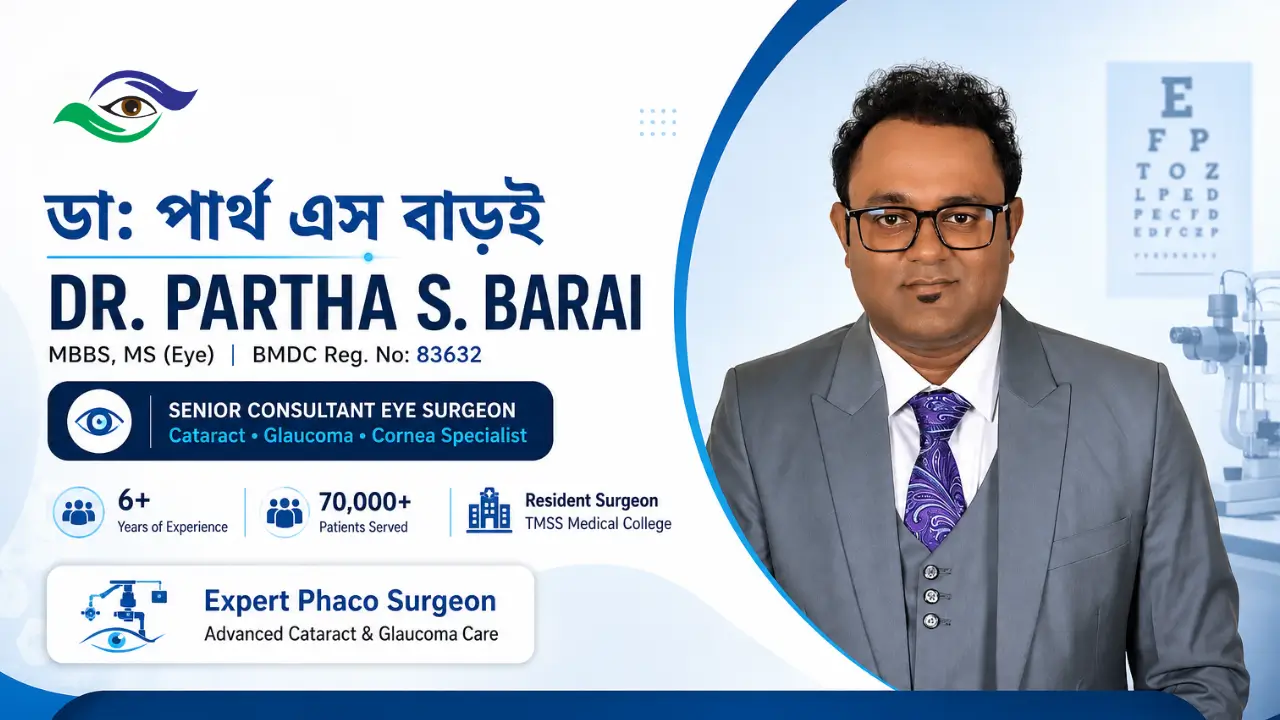
Most people with a visually significant cataract can have phacoemulsification. However, premium IOLs are not for everyone. Multifocal lenses, for example, need a healthy retina and optic nerve; advanced glaucoma, macular degeneration, or diabetic retinopathy may reduce the benefit. A very dense or complicated cataract, corneal scarring, or an unstable eye can also affect lens measurements and surgical planning. During a consultation, the ophthalmologist checks corneal shape, eye length, retina, and optic nerve before recommending a lens. A detailed discussion of your daily activities — reading, driving, work, hobbies — helps decide whether a monofocal, toric, or multifocal lens is the right fit. An experienced eye surgeon such as Dr. Partha S. Barai can help you understand these choices in the context of your own eye exam. If in-person advice is needed, contact with Dr. Partha S. Barai.
Preparation, Procedure, and Recovery
Before surgery – A comprehensive eye exam is done first. This includes biometry to measure the eye, corneal imaging, and a retinal check. The surgeon may ask you to use antibiotic eye drops for a day or two before the operation. Do not stop any regular medication unless the treating doctor advises it.
During surgery – The operation is usually a day-care procedure. Anaesthetic drops are placed on the eye, the area is cleaned, and the surgeon makes a small self-sealing wound. Phacoemulsification removes the cataract, and a foldable IOL is inserted. The procedure typically lasts 15–30 minutes, depending on the case.
After surgery – A protective shield is worn, especially while sleeping. The surgeon prescribes antibiotic and anti-inflammatory drops. Mild grittiness, watering, and blurred vision are common in the first day.
Recovery timeline – Most people see improvement within 24–48 hours. During the first week, avoid heavy lifting, bending, and swimming. Corneal healing continues for several weeks, and the final glasses prescription is usually stable by 4–6 weeks. With premium lenses, the brain may need additional time to adapt to the new depth of focus. If in-person advice is needed, Dr. Partha S. Barai.
Risks and Considerations
Phacoemulsification is generally low-risk, but no surgery is risk-free. Possible complications include:
- Infection or inflammation — uncommon with sterile technique and antibiotic drops.
- Transient raised eye pressure.
- Posterior capsule opacification (PCO) — a later clouding behind the lens that can be treated with a laser.
- Retinal detachment, cystoid macular oedema, or corneal swelling — uncommon.
Premium IOLs add specific considerations. Multifocal lenses can cause glare or halos at night, and contrast sensitivity may be reduced in dim light. Most people adapt, but those who drive frequently at night should discuss this carefully. Toric lenses can rotate slightly after surgery, and repositioning is occasionally needed. A careful pre-operative examination and an experienced surgeon reduce — but do not eliminate — these risks.
Alternatives to Advanced Phacoemulsification
Not everyone needs premium phaco. Alternatives include:
- Manual small-incision cataract surgery (SICS): Common in Bangladesh, especially in public hospitals and for very hard cataracts. It uses a larger wound and often a stitch, with a slightly longer recovery. It is less expensive.
- Basic phacoemulsification with a monofocal IOL: Uses the same small-incision technique and provides good distance vision, but reading glasses are still needed for near work.
- Delayed surgery with observation: Small cataracts that do not affect daily activities may be monitored by an ophthalmologist before surgery is considered.
The choice is based on the density of the cataract, the health of the eye, the patient’s visual needs, and budget.
Approximate Cost of Advanced Phacoemulsification in Bogura
The cost of cataract surgery depends on the surgeon’s fee, facility class, type of IOL, pre-operative tests, and any complications. Private hospitals in Bogura usually include the surgery, the standard IOL, and follow-up visits in a package. Public-sector facilities are considerably cheaper but may only offer manual SICS with a standard lens.
| Item | Approx. BDT range | Notes |
|---|---|---|
| Basic phacoemulsification with monofocal IOL (package) | BDT 25,000 – 45,000 | Usually includes surgery, standard IOL, and basic follow-up; surgeon fee often included. |
| Advanced phacoemulsification with premium IOL (multifocal or toric) | BDT 70,000 – 1,50,000 or more | Premium lens is the main cost driver; may include extra imaging and consultations. |
| Femtosecond laser assistance, if available | Additional BDT 20,000 – 40,000 | Confirm availability in Bogura; not offered at every centre. |
| Surgeon fee when not bundled | BDT 10,000 – 30,000 | Often included in package; separate fee may apply for premium-IOL planning. |
| Extended stay only for complications | BDT 5,000 – 15,000 per day | Rarely needed; for example, if uncontrolled eye pressure or infection occurs. |
These figures are approximate and change over time. A private facility in Bogura may charge more or less depending on equipment and implant brand. Public hospitals such as Bogura Medical College Hospital often charge far less, but advanced IOLs and sutureless phaco may not be routinely accessible there. At Netraloy Eye Care Center, the final cost is shared only after the pre-operative evaluation and lens selection. Always confirm the current quote with the facility before planning surgery.
When to See a Doctor
See an ophthalmologist if you notice:
- Blurry or cloudy vision that makes reading, driving, or recognising faces difficult.
- Increased glare, halos, or double vision in one eye.
- Frequent changes in glasses prescription over a short period.
- Difficulty seeing in dim light or colours appearing dull.
There is no emergency to remove a cataract, but waiting until the lens becomes very hard can make surgery more complex and recovery slower. If these symptoms are interfering with daily life, a full eye examination is the next step. To arrange a check-up, contact with Dr. Partha S. Barai directly.
Frequently Asked Questions
How long does the surgery take, and will I be awake during the procedure?
Advanced phacoemulsification typically takes 15–30 minutes per eye. Most procedures in Bogura are performed under topical anaesthesia — numbing eye drops — so you remain awake but feel no pain. You may see light and movement but not the surgery itself. Your surgeon will guide you through the process.
Can I have both eyes operated on the same day?
Most eye surgeons in Bogura recommend operating on one eye at a time, usually with a gap of 1–4 weeks. Same-day bilateral surgery carries a slightly higher risk of infection or refractive error and is generally reserved for specific medical or logistical reasons. Always discuss the timing with your surgeon.
Will I still need glasses after advanced phacoemulsification?
It depends on the type of intraocular lens (IOL) you choose. Standard monofocal lenses correct distance vision clearly, but you will likely need reading glasses. Premium lenses — such as multifocal or toric IOLs — can reduce dependence on glasses for both distance and near, but no lens guarantees perfect vision for all tasks. Your surgeon will help you select the option that matches your lifestyle.