Best Eye Specialist in Bogura
If you are searching for the best eye specialist in Bogura, you want reliable, skilled eye care for yourself or a family member. The honest answer is that no single doctor is universally the best — the right specialist depends on your specific eye condition, the doctor’s training and subspecialty, and the hospital’s facilities. This article guides you on how to identify a qualified specialist in Bogura using practical, verifiable criteria so you can make an informed choice.
How to Identify a Qualified Eye Specialist in Bogura
In Bangladesh, a qualified ophthalmologist (eye specialist) must have an MBBS degree plus a postgraduate qualification such as FCPS (Fellow of the College of Physicians and Surgeons) or MS (Master of Surgery) in Ophthalmology. Registration with the Bangladesh Medical & Dental Council (BMDC) is mandatory; you can verify this through the DGHS online directory.
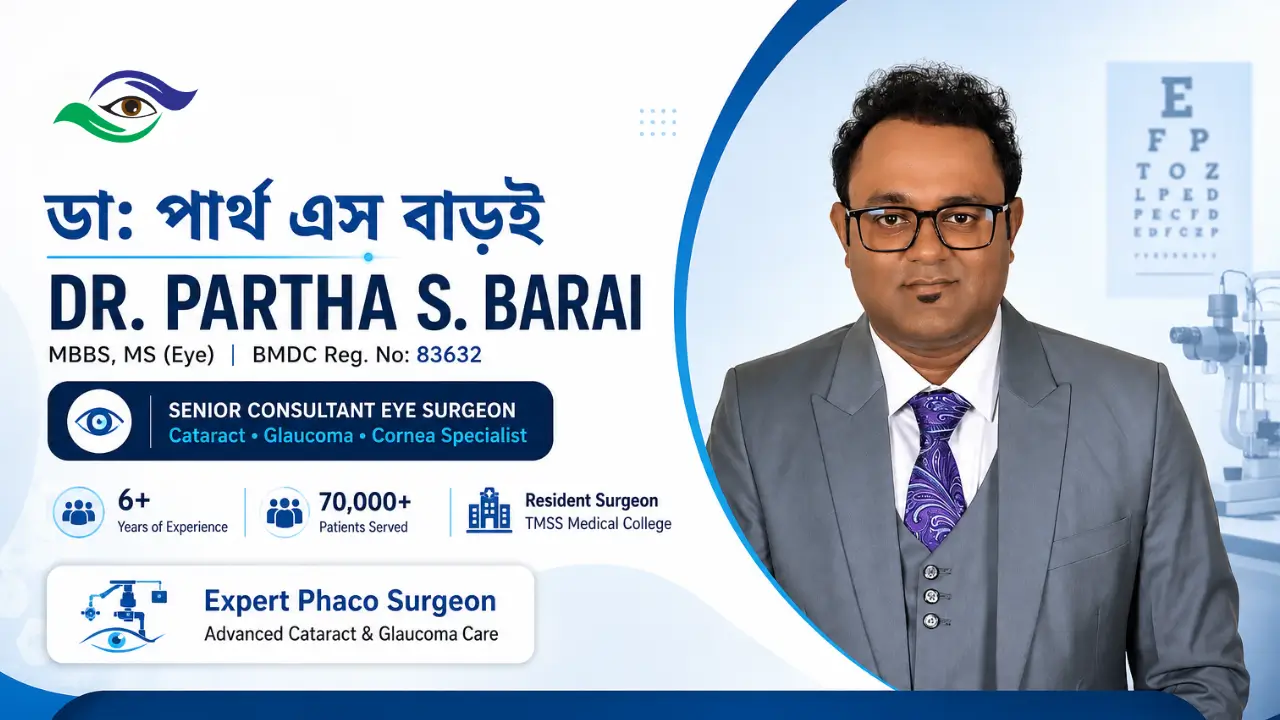
Beyond basic qualifications, many specialists pursue subspecialty training in cataract and refractive surgery, glaucoma, retina, or pediatric ophthalmology. When choosing a doctor, ask about their specific training and experience with your condition. For example, Dr. Partha S. Barai ( learn more on the about page ) is an eye specialist practicing in Bogura with expertise in cataract surgery, refractive errors, and diabetic eye care. You can contact with Dr. Partha S. Barai at Netraloy Eye Care Center for a consultation.
Common Eye Conditions Treated in Bogura
Different eye conditions require different expertise. Matching your condition to the right specialist improves your outcome. Below are common eye problems seen in Bogura and the type of specialist who typically treats them.
| Condition | Description | Subspecialist |
|---|---|---|
| Cataract | Clouding of the eye’s natural lens, common with aging | Cataract & refractive surgeon |
| Refractive errors | Nearsightedness, farsightedness, astigmatism | Optometrist (for glasses) or refractive surgeon (for laser) |
| Glaucoma | Damage to the optic nerve, often linked to high eye pressure | Glaucoma specialist |
| Diabetic retinopathy | Retinal damage caused by diabetes | Retina specialist |
| Conjunctivitis | Infection or inflammation of the conjunctiva (pink eye) | General ophthalmologist |
Factors to Consider When Choosing an Eye Specialist
Beyond credentials, these practical factors matter:
- Experience: Ask how many similar procedures the doctor has performed. For surgery, inquire about complication rates.
- Hospital reputation: A well-equipped facility with modern tools (OCT, visual field analyzer, biometry) improves diagnosis and treatment.
- Patient reviews: Word-of-mouth from family or online reviews on Google Maps can indicate bedside manner and reliability.
- Location and accessibility: Choose a clinic that is convenient for follow-up visits.
- Rapport: You should feel comfortable asking questions; a good specialist explains things clearly.
For instance, Netraloy Eye Care Center (details at Netraloy Eye Care Center) is one facility in Bogura that offers general ophthalmology and cataract surgery, staffed by experienced doctors like Dr. Partha S. Barai. If in-person advice is needed, contact with Dr. Partha S. Barai.
Recognized Eye Hospitals and Clinics in Bogura
Bogura has several eye care facilities with varying services. None is ranked as ‘best,’ but each serves different needs. Always verify current services and doctor availability directly.
| Facility | Key Services | Notes |
|---|---|---|
| Netraloy Eye Care Center | General ophthalmology, cataract surgery, refractive errors, diabetic eye care | Run by Dr. Partha S. Barai. Phone: 01711141737. Netraloy Eye Care Center |
| Bogura Eye Hospital | Cataract surgery, glaucoma management, pediatric eye care | Well-known local facility; check current specialist roster |
| Islami Bank Hospital, Bogura | General ophthalmology, diabetic retinopathy screening | Offers outpatient and inpatient eye services |
When to See an Eye Specialist vs. an Optometrist
An optometrist holds a Bachelor’s in optometry and handles vision testing, glasses, contact lenses, and minor eye issues — they do not perform surgery. An ophthalmologist is a medical doctor who can diagnose all eye diseases, perform surgery, and manage complex conditions like glaucoma or diabetic retinopathy.
See an optometrist for routine vision checks and glasses. See an ophthalmologist if you have eye pain, vision loss, flashes of light, floaters, diabetes, or need surgery. For example, if you need cataract surgery, you can contact with Dr. Partha S. Barai, an ophthalmologist at Netraloy Eye Care Center. If in-person advice is needed, Dr. Partha S. Barai.
Questions to Ask During Your Consultation
Prepare these questions before your visit:
- What is my exact diagnosis and its cause?
- What treatment options are available, and what are the pros and cons?
- If surgery is recommended, how many similar procedures have you performed, and what is your success rate?
- What are the possible risks and side effects?
- What is the follow-up plan and how many visits will I need?
- Are there lifestyle changes I should make (e.g., diet, screen time, diabetes control)?
To schedule a consultation, check the chamber hours and address of Netraloy Eye Care Center.
Typical Costs for Eye Care in Bogura
Costs vary widely between public and private facilities. The table below shows approximate ranges — always confirm current prices directly with the facility before proceeding.
| Item | Approx. Range (BDT) | Notes |
|---|---|---|
| Consultation fee (private clinic) | 300 – 500 | May be higher for senior specialists; free at public hospitals |
| Cataract surgery (private hospital, per eye) | 15,000 – 35,000 | Includes surgeon fee, lens, and hospital stay; free at public facilities |
| Glaucoma medication (monthly) | 500 – 2,000 | Depends on brand and type of drops |
| Diabetic retinopathy laser session | 3,000 – 8,000 | Per session; multiple sessions may be needed |
| Eye examination (refraction) | 200 – 500 | Often included in consultation fee |
Important: These are approximate ranges and may change. Confirm costs with the facility before starting treatment. Public hospitals in Bogura offer many eye services free of charge or at nominal rates.
Frequently Asked Questions
How do I know if my eye condition requires a specialist rather than an optometrist in Bogura?
Optometrists in Bangladesh handle routine vision checks, prescribe glasses or contact lenses, and treat minor surface eye infections. However, if you have symptoms like sudden vision loss, eye pain, flashing lights, floaters, redness lasting more than a few days, or a known condition like glaucoma, cataract, or diabetic retinopathy, you should see an MBBS doctor with a Diploma or FCPS in Ophthalmology (an eye specialist). Optometrists are not medically trained to diagnose or treat diseases of the eye beyond basic refraction.
Can I directly go to a hospital in Bogura for an eye emergency, or should I find a specific doctor first?
For true eye emergencies — such as chemical injury, blunt trauma, sudden vision loss, or a foreign object that won’t flush out — go directly to the nearest hospital with an ophthalmology department. In Bogura, hospitals like Bogura Shaheed Ziaur Rahman Medical College Hospital or a well-equipped private hospital will have emergency ophthalmologists on call. Delaying care to book a specific specialist can worsen the outcome.
What does an ‘eye specialist’ mean in Bangladesh, and how can I verify their credentials in Bogura?
In Bangladesh, an eye specialist (ophthalmologist) is a medical doctor (MBBS) who has completed postgraduate training in eye diseases — usually a Diploma in Ophthalmology (DO) or an FCPS in Ophthalmology (Fellowship of the College of Physicians and Surgeons). You can verify their registration with the Bangladesh Medical and Dental Council (BMDC) by checking the doctor’s displayed credentials at the clinic or searching online through the BMDC register. No additional subspecialty (e.g., cornea, retina, pediatric) means they manage general eye conditions.
How often should someone with diabetes visit an eye specialist in Bogura, even without symptoms?
If you have type 1 or type 2 diabetes, you should have a dilated eye exam at least once a year, even if your vision seems normal. Diabetic retinopathy often has no early symptoms but can cause irreversible damage. In Bogura, many specialist clinics offer retinal screening. If you already have diabetic eye changes, your specialist may recommend more frequent visits, sometimes every 3 to 6 months. Always follow the follow-up schedule they set.
Do all eye specialists in Bogura perform cataract surgery, and what should I ask before agreeing?
Not every eye specialist performs cataract surgery — some focus only on medical management (like treating glaucoma or infections). For surgery, you need an ophthalmologist who is trained in small-incision cataract surgery (SICS) or phacoemulsification. Before agreeing, ask: (1) How many cataract surgeries do you perform per month? (2) What type of intraocular lens (monofocal, multifocal, toric) do you recommend for my needs? (3) What are your typical outcome rates (infection, posterior capsule opacification)? A high-volume surgeon in a well-equipped hospital typically has better outcomes.